
Key Takeaways
- Multichannel means being present on many channels; omnichannel means those channels are connected.
- Start from one customer journey, give every channel a job and sequence messages from story to proof to offer.
- First-party data and server-side tracking are the fuel AI-driven ad platforms depend on.
- Measure blended CAC and marketing efficiency ratio, and test before cutting awareness channels that look weak in last-click reports.
Monday morning, your customer sees your Instagram ad about a summer sale. At lunch, a Google search ad promises free shipping. That evening a YouTube pre-roll talks about sustainability. On Thursday, your email says "New arrivals!"
Four touchpoints. Four messages. Zero memory of any of them.
This is how most brands advertise. Each channel has its own owner, its own agency, its own budget and its own idea of success. Meta reports a great ROAS. Google reports a great ROAS. Add them up and you've apparently generated more revenue than your bank account shows.
Omnichannel advertising fixes this by treating every channel as one campaign with one customer journey. Done well, it lowers acquisition costs, lifts conversion rates and makes your brand feel bigger than its budget. Here's how to build it.
What is omnichannel advertising?
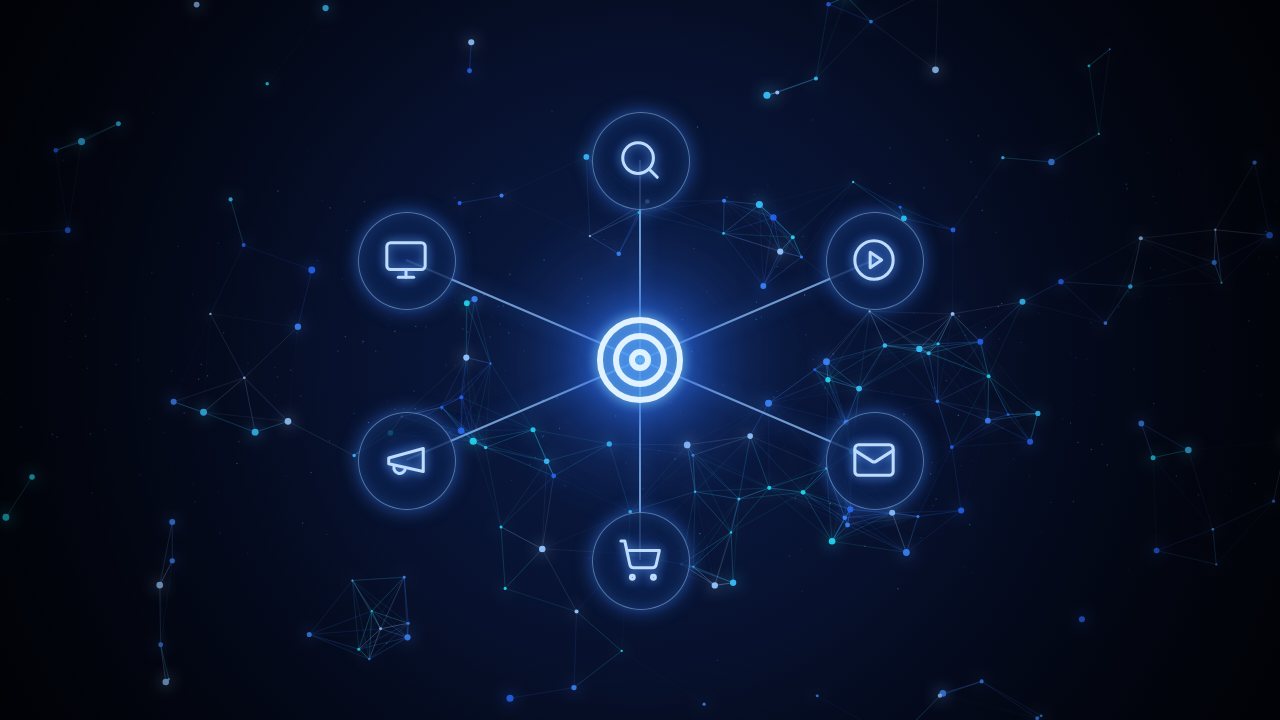
Omnichannel advertising is running paid media across search, social, video, display, connected TV and retail channels as one coordinated program. Every ad shares the same audience strategy, the same core message and one measurement framework, and each channel plays a defined role in the buyer's journey.
It's often confused with multichannel. The difference is simple:
- Multichannel means you're present on many channels. Each one runs on its own.
- Omnichannel means those channels are connected. What someone saw on TikTok shapes what they see on Google, and what they clicked on Google shapes the email they get next.
Most brands are multichannel. Very few are truly omnichannel. That gap is where the efficiency is hiding.
Why omnichannel matters more in 2027
Three years ago you could pick one channel, find a winning audience and scale it. That gets harder every quarter.
- Signal loss is permanent. Privacy changes on iOS, tighter consent rules in the UK and EU, and browser limits on tracking mean each platform sees less of the journey. No single channel can find and convert customers on its own anymore.
- Platforms run on AI automation. Meta Advantage+ and Google Performance Max decide much of the targeting for you. What you control now is the creative, the offer and the first-party data you feed them. Those inputs work best when they're consistent across channels.
- Costs keep climbing on crowded platforms. When one channel saturates, brands that already have other channels working can shift budget. Single-channel brands just pay more.
- Buyers move between screens constantly. They discover on social, research on search and AI assistants, and buy on a phone, laptop or in-store. A message that follows them coherently is remembered. Scattered messages aren't.
The brands that win aren't the ones with the biggest budget on one platform. They're the ones whose channels reinforce each other.
How to build an omnichannel ad strategy in 6 steps
- 1Start with one customer journey, not channel plans. Map how your best customers actually found you, compared options and bought. Use sales calls, post-purchase surveys and analytics. That journey becomes the plan.
- 2Write one core message and a creative system. Define the main promise, two or three proof points and a visual identity. Each channel adapts the format, not the story. A 6-second TikTok hook and a search ad headline should clearly come from the same brand.
- 3Build a first-party data foundation. Collect emails, purchase data and site behavior with clear consent. Sync audiences into your ad platforms through server-side tracking and conversion APIs. This is the fuel AI-driven campaigns depend on.
- 4Give every channel a job. Some channels create awareness, some capture intent, some close. Judge each one on its job, not on last-click ROAS alone (see the table below).
- 5Sequence the messages. Someone who watched 75% of your YouTube ad should see a different follow-up than someone who's never heard of you. Use engagement-based audiences to move people from story to proof to offer.
- 6Measure the whole, not the parts. Track blended metrics like total CAC and marketing efficiency ratio (total revenue divided by total ad spend). Add incrementality tests, such as pausing a channel in one region, to see what each channel truly adds.
What job each channel should do
This is a starting point. Your mix depends on your category, average order value and sales cycle.
| Channel | Main job | Judge it on |
|---|---|---|
| YouTube and connected TV | Build awareness and trust at scale | Reach, view rate, branded search lift |
| TikTok and Instagram Reels | Spark discovery with short-form stories | Engagement, cost per engaged view, site visits |
| Meta (Facebook and Instagram) | Prospect and retarget with proof and offers | Cost per acquisition, new customer rate |
| LinkedIn (B2B) | Reach decision-makers by role and company | Account engagement, pipeline influenced |
| Google Search and Shopping | Capture people already looking | Conversion rate, CPA, impression share |
| Retail media (Amazon, Walmart) | Win at the digital shelf | Return on ad spend, share of category |
| Email and SMS | Convert and retain owned audiences | Revenue per subscriber, repeat purchase rate |
A warning about cutting "low ROAS" channels: awareness channels often look weak in last-click reports. Turn them off and, a few weeks later, your search and retargeting results usually drop too. Test before you cut.
FAQ
What's the difference between omnichannel and multichannel advertising?
Multichannel means advertising on several channels independently. Omnichannel means those channels share one audience strategy, message and measurement framework so they work as a single journey.
How much budget do you need for omnichannel advertising?
You don't need to be on every channel. Start with two or three that match your customer journey, such as one awareness channel, one intent channel and email. Add channels as each one proves its role.
How do you measure omnichannel ROI?
Use blended metrics like total CAC and marketing efficiency ratio alongside incrementality tests. Platform-reported ROAS alone will over-count, because every platform claims credit for the same sale.
Is omnichannel only for big brands?
No. Smaller brands often benefit more, because consistent messaging makes a modest budget feel bigger and more memorable.
Make every ad dollar work with the others
Growth Intellects plans and runs omnichannel advertising for ecommerce, DTC and B2B brands across Meta, Google, YouTube, TikTok, LinkedIn and more, guided by fractional CMO strategy and clear blended reporting.
Related articles


Zeba Warsi
AI-Driven Growth Strategist
Zeba Warsi is an AI-first growth strategist focused on scaling brands through performance marketing, intelligent automation, and data-driven decision-making. With hands-on experience across global markets, Zeba specializes in turning insights into scalable strategies, driving traffic, optimizing conversions, and unlocking sustainable digital growth. She actively shares practical, future-ready marketing frameworks to help businesses stay competitive in an AI-powered landscape.